
Managing enterprise wireless at scale has never been straightforward, and for many organisations the visibility simply is not there until something breaks. By the time a fault surfaces through the helpdesk, users have already been impacted and the clock is already running on resolution.
HPE Juniper MIST Wireless Assurance is designed to address exactly that gap. Drawing on AI, machine learning, and continuous telemetry collected from Juniper’s Access Point portfolio, MIST provides network teams with a clear and accurate picture of wireless performance at all times, surfacing potential issues before they translate into user complaints.
The result is a platform that does not just report on the state of your network, but actively works to maintain the standard of service your organisation depends on.
HPE Juniper MIST Wireless Assurance: Service-Level Expectations (SLEs)
Central to this is the concept of Service-Level Expectations (SLEs). These are configurable performance thresholds that you set based on what good looks like for your environment. MIST then continuously measures the network against them, producing a health score across seven areas:
- Time to Connect: how long the full connection process takes, from association through to IP assignment
- Successful Connects: what proportion of connection attempts are actually completing
- Coverage the signal strength being received by active clients across the site
- Roaming: how cleanly and quickly clients are moving between access points
- Throughput: the real-world bandwidth clients are getting, factoring in device capability and RF conditions
- Capacity: channel utilisation and client density, useful for spotting congested radios and interference
- AP Health: the overall condition of your AP estate, covering power, uplink connectivity, and cloud reachability
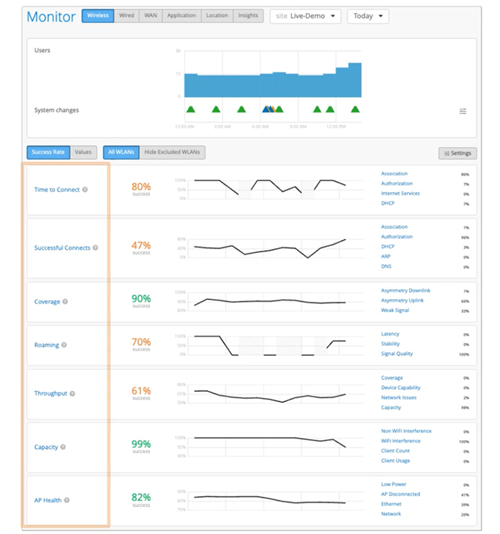
Where SLEs become really useful is in the detail beneath each score. Every metric breaks down into classifiers that tell you not just that something is wrong, but what is causing it.
A dip in Time to Connect might trace back to a DHCP server not responding to renewal requests, which immediately tells you the problem is infrastructure rather than wireless. A roaming score that drops could reveal clients taking over two seconds to complete a standard roam, pointing to a gap in AP coverage or RF design.
Instead of trawling through logs after a complaint lands, you have the context you need to act before it becomes a problem. For larger environments with many sites, this level of granularity scales well — you can view SLE health at an organisation level and drill down into a specific site or building without losing the thread of what you are looking at.
Sitting alongside SLEs is Marvis Actions
Marvis continuously analyses your environment and surfaces prioritised actions for administrators to work through, things like APs that have gone offline, missing VLANs, firmware inconsistencies across the estate, or radios showing signs of congestion. Some of these it can resolve autonomously. Others flag the issue and point you in the right direction, particularly where the problem sits outside of MIST’s direct control, such as an upstream DHCP server or a third-party routing change.
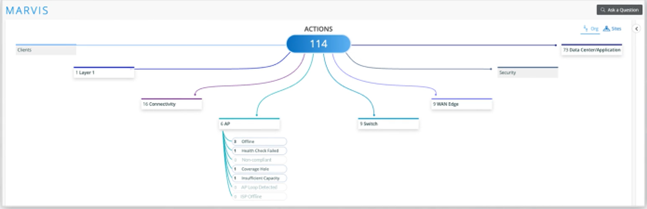
Once an issue is resolved the action clears, so your actions list becomes a reliable indicator of network health rather than just a noise feed. Over time, Marvis gets better as the more data it accumulates from your environment, the more informed its decisions become.
The platform also includes some genuinely practical troubleshooting tools that save a lot of engineering time in the field. Dynamic Packet Capture automatically stores wireless captures in the MIST cloud, so when a user reports an intermittent issue you are not scrambling to replicate it with a dedicated sniffer or waiting for it to happen again. The data is already there. Combined with the per-client visibility MIST provides, including connection history, signal metrics, and roaming events, you can get to the bottom of most wireless complaints in a fraction of the time it would take with traditional tools.
There is also a strong API underpinning the whole platform, which makes it straightforward to pull MIST data into existing ITSM workflows or automation pipelines if that is something your team is looking to build out.
Conclusion
For organisations running complex or large-scale wireless environments, whether that is a multi-site enterprise, a hospital network, or a high-density venue, MIST represents a meaningful step forward in how wireless is managed. It moves the conversation away from break-fix and towards genuine assurance. The network is either meeting the standard you have set, or MIST is already working out why it is not.
At WhiteSpider, we architect, implement, and deliver managed WLAN services powered by solutions like Juniper MIST across healthcare and enterprise environments. The shift this enables in wireless operations, through greater visibility, automation, and control, is consistently one of the most valuable outcomes our customers see.
If you’re interested in finding out more about MIST or HPE Juniper’s networking portfolio, talk to one of our networking specialists today.